

Tsunami Science
Tsunamis start because of a sudden displacement of ocean water, usually from an earthquake.
Tsunamis start because of a sudden displacement of ocean water, usually from an earthquake.

World Data Center-A for Marine Geology and Geophysics Report MGG-12 (1996) Published by the National Geophysical Data Center
Age of the Ocean Floor Read More »
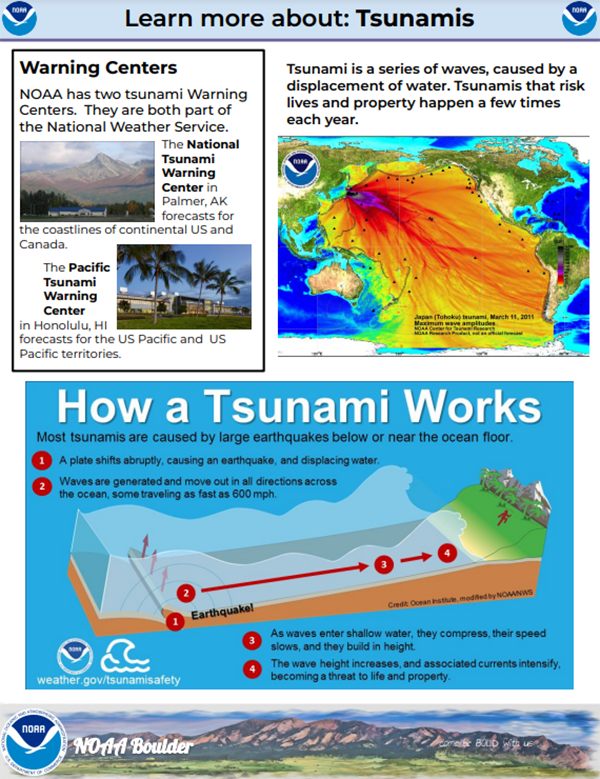
Printable information about tsunamis
Learn More About Tsunamis Read More »

On May 22, 1960 and magnitude 9.5 earthquake occurred off the coast of southern Chili in South America. This earthquake is the largest magnitude ever recorded by instruments. The earthquake caused a tsunami that greatly impacted Chile, and as far away as Hawaii, Philippines and Japan.

Through the lessons in this module, designed for grades 6-12, students are guided through the use of NOAA data (sea surface temperature and SST anomalies, coral bleaching hotspots, and degree heating weeks) to understand how scientists monitor coral bleaching events in order to determine what is happening to the health of coral reefs in the world’s oceans. The module offers lessons at five different levels, beginning with basic graph interpretation (Levels 1 & 2) and building towards activities that challenge students to ask questions and develop their own data investigations (Levels 4 & 5).
Investigating Coral Bleaching Read More »

Students will analyze and interpret data from the Okeanos Explorer to make inferences about the possible presence of hydrothermal vents.
The Oceanographic Yoyo (Ocean Chemistry and Hydrothermal Vents) Read More »

Students will explain how multibeam sonar is an example of
advances in engineering that have extended the measurement,
exploration, modeling, and computational capacity of scientific
investigations.
Wet Maps (Bathymetry) Read More »

This lesson guides student investigations into reasons for ocean
exploration. Other lessons in Volume I, Why Do We Explore guide additional investigations into key topics of Ocean Exploration,
Energy, Climate Change, Human Health, and Ocean Health.
To Boldly Go (Ocean Exploration) Read More »

The classroom activity package Winged Ambassadors – Ocean Literacy through the Eyes of Albatross is available free online courtesy of NOAA, Oikonos, and other partners. Albatrosses, charismatic and threatened seabirds, are ambassadors for a clean ocean because they traverse vast oceanic regions searching for floating food. Along their journeys, they ingest plastic trash and feed it to their chicks. These five lessons comprise new and modified activities, using inquiry-based science instruction, aligned to new standards for grades 6 – 8 with extensions for grades 9 – 12.
Winged Ambassadors: Ocean Literacy Lessons Read More »

Students will understand the importance of the diversity of life in the Atlantic Ocean. Students will discover facts about the different aquatic organisms and their existence in the marine ecosystem.