
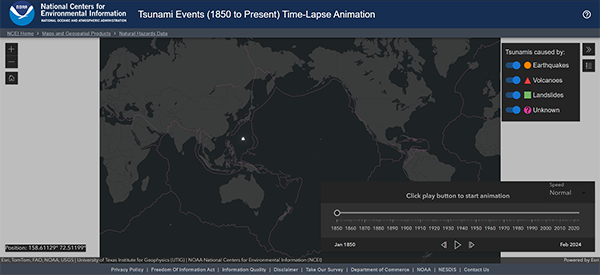
Tsunami Events: 1850-Present
What the time-lapse of events with a tsunami from the year 1850 to present day.
Tsunami Events: 1850-Present Read More »
What the time-lapse of events with a tsunami from the year 1850 to present day.
Tsunami Events: 1850-Present Read More »
Welcome to “NOAA and the Octonauts,” an episode-by-episode discussion of the children’s TV show the Octonauts, which features a crew of quirky and courageous undersea adventurers. Their mission: to explore the world’s ocean, rescue the creatures who live there, and protect their habitats. Our monthly podcast brings together experts from inside and outside of NOAA to help you and the children you care about learn more about the real-life versions of the Octonauts sea creatures and the ocean they call home.
Podcast: NOAA and the Octonauts Read More »

NOAA Corps Officer Marisa explains what it’s like to work on a ship doing NOAA science on the ocean.
Ask a Scientist: Do You Live in the Ocean? Read More »

The National Marine Sanctuary System protects some of the most iconic underwater places throughout the United States, but we can’t do it without you. No matter where you are, the ocean and Great Lakes are in your hands. We hope these images inspire you to help care for our ocean and to spread the word that Earth isn’t green – it’s blue.
Videos From National Marine Sanctuaries Read More »

National Centers for Environmental Information (NCEI) Scientist Nicolas Arcos teams up with Cooperative Institute for Research in Environmental Sciences Scientist Lindsey Wright to explains Tsunamis.
Do You NOAA: Tsunamis Read More »

NOAA’s Physical Sciences Laboratory (PSL) Scientist and Janet Intrieri explains what is happening to Arctic sea ice .
Do You NOAA: Arctic Ice Melt Read More »

Most reef-building corals are made up of hundreds of thousands of individual polyps like this one. These polyps generally range in size from one to three millimeters in diameter.
Anatomy of a coral polyp Read More »

Hydrography is the science that measures and describes the physical features of bodies of water and the land areas adjacent to those bodies of water.

Tsunamis start because of a sudden displacement of ocean water, usually from an earthquake.

World Data Center-A for Marine Geology and Geophysics Report MGG-12 (1996) Published by the National Geophysical Data Center
Age of the Ocean Floor Read More »